Skip to Main Content Skip to Footer Content

Mr. Electric of Tampa Bay Blog

Shared Resources for Your Home Needs

FEATURED BLOG
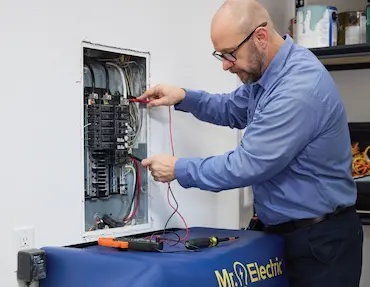
Professional Mr. Electric technician testing a residential electrical panel to ensure home safety during National Electrical Safety Month.

National Electrical Safety Month: Your Guide to Checking Electrical Hazards in Your Home

May is National Electrical Safety Month, making it the ideal time to check the systems that homeowners rely on every day. Electrical hazards often develop quietly through overloaded circuits, aging panels, or outdated outlets until they become costly or dangerous problems.

Read More

Showing 15 Results for Home Safety

Home Safety Home Safety

Sep 24 2026

If your circuit breaker keeps tripping, the most likely cause is that your electrical panel does not have enough capacity for the total power your household draws. Homes in Hyde Park, Palma Ceia, Davis Islands, Carrollwood, and Old Northeast were built with 100-amp or 150-amp panels sized for the electrical loads of the 1970s, 1980s, and 1990s. Those loads no longer reflect how Tampa Bay families live. EV chargers, dual-zone HVAC systems, pool equipment, home offices, induction cooktops, tankless water heaters, and smart home devices have collectively pushed residential power demands well beyond what these original panels were engineered to handle.

Learn more

Home Safety Home Safety

Sep 24 2026

At Mr. Electric of Tampa Bay we know the summer is not just hot, it is the most electrically hazardous season anywhere in the continental United States. Hillsborough County averages 1.2 million lightning strikes per year. Afternoon thunderstorms roll through daily from June through September, producing lightning, power surges, heavy rain, wind-driven debris, and localized flooding that stress every component of your home’s electrical system. The official Atlantic hurricane season runs from June 1 through November 30, extending that risk window across nearly half the year.

Learn more

Home Safety

Sep 24 2026

After Hurricanes Helene and Milton left millions of Tampa Bay residents without power in 2024 some for days, others for weeks the question is no longer whether Tampa homeowners need backup power. It is which technology is the right fit. The two dominant options in 2026 are the gas-powered standby generator, represented by the Generac 22kW Guardian (the industry benchmark), and the modular battery backup system, represented by the Anker Solix E10 (the category’s newest and most capable entry).

Learn more

Home Safety

Sep 24 2026

Few topics in residential electrical work generate as much confusion as aluminum wiring. Homeowners hear that aluminum wiring is dangerous and assume every wire in the house is a fire hazard. Insurance inspectors flag it on 4-point reports and request remediation. Social media videos show burned connections and melted terminals. And yet, aluminum conductors remain a code-compliant, widely used material in modern residential electrical systems for specific applications.

Learn more

None Home Safety

Sep 21 2026

The right generator size for a Tampa Bay home is based on electrical load which circuits must run at the same time not square footage. Most Tampa homes land in one of three tiers: essential loads only (10–14 kW, no central AC), most-of-house backup including one AC system (18–22 kW, where most homeowners land), or whole-home backup (22–28+ kW). Because Tampa runs air conditioning nearly year-round and many homes have pool pumps and electric water heaters, loads run heavier than national averages. The exact size comes from an on-site load calculation under NEC Article 220.

Learn more

None Home Safety

Sep 17 2026

The right backup power system for a Tampa Bay home is determined by neighborhood, not brand: your utility (TECO in Hillsborough, Duke Energy in Pinellas), whether natural gas reaches your street, your lot size and setbacks, HOA rules, and flood exposure decide whether a natural gas standby, a propane standby, or an Anker Solix E10 battery system makes sense. A complete, permitted 22 kW natural gas installation typically runs $12,000–$15,000 in 2026; propane $12,000–$17,000; and a fully configured E10 battery system $10,000–$15,000. All installations are governed by the 2020 NEC under Florida’s 8th Edition Building Code and require a permit.

Learn more

Book Online

By checking this box, I agree to opt in to receive automated informational and promotional SMS and/or MMS messages from Mr. Electric, a Neighborly company, and its franchisees to the provided mobile number(s). Messages & data rates may apply. Message frequency varies. View Terms and Privacy Policy. Reply STOP to opt out of future messages. Reply HELP for help.

By entering your email address, you agree to receive emails about services, updates or promotions, and you agree to the Terms and Privacy Policy. You may unsubscribe at any time.

About Mr. Electric

Established in 1994, Mr. Electric® is a global franchise organization providing electrical installation and repair services. Recognized by Entrepreneur magazine among its “Franchise 500,” Mr. Electric franchisees provide these services to both residential and commercial customers at almost 200 locations worldwide. Mr. Electric is a subsidiary of the Neighborly® family of service franchises.
Learn More